
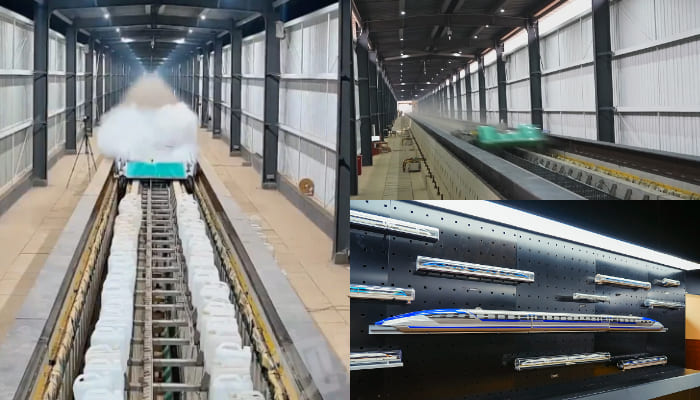
China has set a new global benchmark in high-speed transportation technology. It accelerated a tonne-class maglev vehicle to an extraordinary speed of 700 km/h in just two seconds. The milestone was achieved by researchers at the National University of Defence Technology (NUDT). The test was conducted on a 400-metre magnetic levitation track. The vehicle was also brought to a safe and controlled stop within the same short distance.
🎉A one-ton test vehicle in China broke the world record by reaching a speed of 700 km/h in 2 seconds on a superconducting maglev(derived from magnetic levitation) track. pic.twitter.com/YBpfEBAlE7
— murаt kgirgin (@muratkgirgin) December 25, 2025
World’s Fastest Superconducting Electric Maglev
According to China Central Television (CCTV), this test makes the system the fastest superconducting electric maglev in the world. No other superconducting electric maglev has reached this speed to date. Official footage showed a chassis-like vehicle racing across the track, appearing as a blur due to the extreme speed.
A visible trail of mist followed the vehicle, caused by the intense acceleration. The experiment demonstrated precise control, showing accuracy in both rapid acceleration and instant braking.
Major Technical Challenges Overcome
The achievement represents a major technological leap and highlights China’s progress in extreme-speed transport systems. The research team resolved several core technical challenges, including ultra-high-speed electromagnetic propulsion, electric suspension, and guidance systems.
Another breakthrough was achieved in transient high-power energy storage inverters. The use of high-field superconducting magnets was also mastered. Together, these advances place China among global leaders, ranking it at the forefront of ultra-high-speed maglev technology.
Implications Beyond Rail Transport
The significance of this technology extends beyond rail transport. The same electromagnetic acceleration force could assist aerospace launches, helping rockets and aircraft during take-off. This could significantly reduce fuel consumption.
The technology could also enable ground-based simulations of ultra-high-speed flight. Such simulations would support safer testing and improve efficiency when evaluating advanced aerospace equipment.
Pathway to Hyperloop-Style Transport
The breakthrough opens new possibilities for vacuum-pipeline maglev systems, often referred to as hyperloop transport. These systems rely on reduced air resistance to achieve extreme speeds. Such technology could allow travel between cities in just minutes, with the potential to transform long-distance transportation. Logistics and mobility across China could be reshaped.
A Decade of Research and Development
The maglev research team at NUDT has worked on this project for nearly 10 years, focusing on long-term technological refinement. Earlier this year, the same test line reached a speed of 648 km/h. The latest result marks a clear improvement. Professor Li Jie, a senior expert at NUDT, said that it will accelerate China’s ultra-high-speed maglev research and development.
China’s Longstanding Leadership
China’s achievements build on decades of continuous innovation. The country developed its first manned maglev train nearly 30 years ago. Since then, research has expanded into superconducting systems, with experiments on vacuum-pipeline maglev technology also underway.
Today, China continues to push technological boundaries. This record-breaking test confirms its leadership and justifies the claim that China reached 700 km/h in just two seconds, setting a new world standard.