

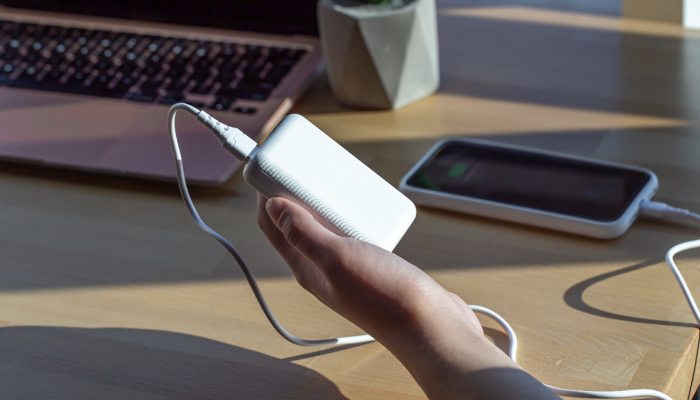
Carrying a power bank on a flight has become common, but most travellers wonder why using it midair is prohibited. According to Dr Harshada Babrekar, PhD, a physics consultant at Maharashtra Knowledge Corporation Limited (MKCL), the answer lies in the very nature of these devices. “Power banks are essentially portable batteries that store and release electrical energy. Think of them as a mini bank for your devices,” she explains. While convenient for powering phones or tablets, their internal mechanisms make them risky under certain conditions.
Inside a Power Bank: How It Works
Most modern power banks use lithium-ion (Li-ion) or lithium-polymer (Li-Po) cells. A Li-ion battery consists of three main components: the anode (negative), cathode (positive), and electrolyte that allows lithium ions to move between them. When the battery discharges to power a device, lithium ions flow from the anode to the cathode, while electrons travel through the circuit, generating electricity. Under normal circumstances, this process is safe. However, damage, overcharging, or short-circuiting can upset this balance.
Thermal Runaway: The Hidden Danger
Dr Babrekar explains thermal runaway: a chain reaction in which a battery produces heat faster than it can dissipate. “This can cause fires, explosions, or the release of toxic gases,” she says. Minor defects, physical damage, or impurities in the battery can trigger this reaction, making even minor incidents potentially dangerous.
High Altitudes Increase Risk
The danger is magnified at cruising altitudes. Aircraft cabins have lower air pressure at around 35,000 ft, which causes gases inside a battery to expand. Even a small internal short can escalate into a serious hazard under these conditions. This explains why airlines forbid using power banks during flights.
Safety Tips for Travellers
Dr Babrekar emphasises that while power banks are useful, knowing their risks is essential. Proper handling, using quality devices, and avoiding damaged units can prevent accidents. Understanding the science behind these devices helps travellers respect safety rules, while still benefiting from portable chargers.
You can carry your power bank on board for emergencies. But using it mid-flight can be far more dangerous than most passengers realise. Awareness and caution are the keys to safe travel.