

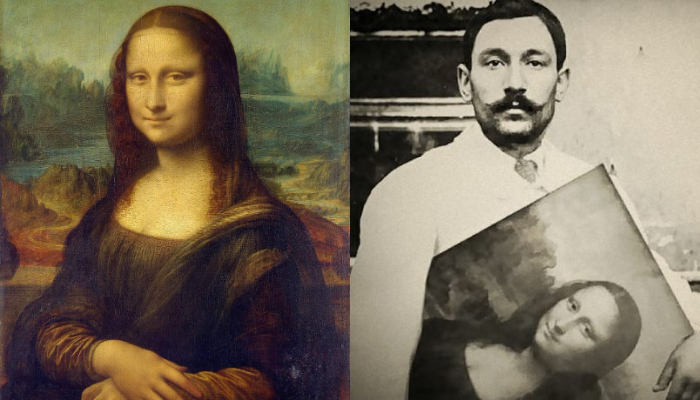
Imagine walking into the Louvre, one of the world’s most iconic museums, only to discover that priceless masterpieces have vanished right under your nose. That’s exactly what happened over a century ago with Leonardo da Vinci’s Mona Lisa, a heist that would go down in history as one of the greatest art thefts of the 20th century.
The Day It Disappeared
It was Monday morning, 21 August 1911, a summer holiday closure day at the Louvre. Vincenzo Peruggia, an Italian mason working at the museum, executed the audacious theft.
Disguised as a museum employee, he had hidden overnight in a closet and, at around 7 am, removed the Mona Lisa from its iron pegs in the Salon Carré, concealing it from everyone. The painting remained missing for nearly two and a half years, leaving the world stunned and police baffled.
Who Was Vincenzo Peruggia?
Born in 1881 in the Italian Alps, Peruggia moved to Paris in 1908. He briefly worked at the Louvre, handling cleaning and reframing duties. His insider knowledge enabled him to bypass security, remove the painting’s protective case, and escape through a service stairway after a chance encounter with a plumber who mistook him for staff.
Motive Behind the Theft
Peruggia claimed he wanted to return the Mona Lisa to Italy, arguing that Napoleon had stolen it—a historically inaccurate notion. Some experts believe patriotism drove him, while others suggest money was the motive.
His attempts to sell the painting involved contacting art dealer Alfredo Geri in Florence under an alias, eventually leading to his arrest in December 1913. During his trial, he served just eight months in prison, and the painting toured Italy before returning to the Louvre.
Painting and Its Fame
The Mona Lisa, painted between 1503 and 1506, depicts Lisa Gherardini, the wife of Florentine merchant Francesco del Giocondo. Acquired by King Francis I of France after Da Vinci’s death, it has been a centrepiece at the Louvre since the late 18th century. Its enigmatic smile and captivating gaze created the famed “Mona Lisa Effect,” making it one of the most analysed and parodied artworks globally.
Cultural Legacy and Pop Culture
The theft cemented the Mona Lisa’s place in popular culture. Films like the 1931 Der Raub der Mona Lisa, TV miniseries such as The Man Who Stole La Gioconda (2006), and songs like Nat King Cole’s 1950s hit Mona Lisa all drew inspiration from the heist. Its value has soared through history, holding the Guinness World Record for the highest-known painting insurance valuation at USD 100 million (Rs 850 Crore) in 1962, about USD 1 billion (Rs 8,500 Crore) today when adjusted for inflation.
The Mona Lisa heist remains a captivating story of audacity, intrigue, and the global fascination with art. Over 114 years later, it continues to inspire films, literature, and endless discussions about art, crime, and human ingenuity.