
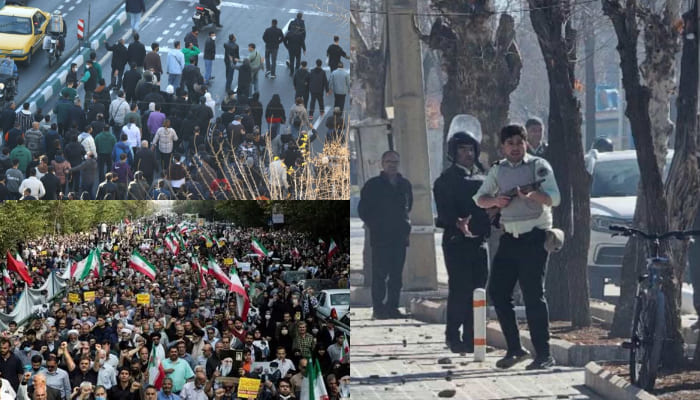
Economic frustration has now ended in bloodshed. Demonstrations driven by an aggravated economic crisis have developed into fatal violent incidents in several provinces, marking the worst wave of unrest Iran has experienced since 2022. Over the past two days, at least seven people have been killed in clashes between protesters, police, and members of the Basij, a volunteer paramilitary division of Iran’s Revolutionary Guard.
Iran protests intensify as Revolutionary Guard officer set on fire by Molotov cocktail on Day 5
Rial collapse sparks biggest uprising since 2022 Mahsa Amini movement
Protesters chant “Death to Khamenei” across Tehran while Basij deploys live fire
Regime is 🅱️urning pic.twitter.com/NyNxAcWjH2
— Boi Agent One (@boiagentone) January 1, 2026
Although the protests have not spread across the entire country, the speed at which they are expanding in western and south-western regions has raised urgent concerns that the nation may be heading towards deeper instability.
21/ Video circulating reportedly shows a protester wounded by security force gunfire in Marvdasht, Fars Province today (Jan. 1).https://t.co/Isvp1bJT8u
— Sina Toossi (@SinaToossi) January 1, 2026
Iranian protests were occasioned by further economic meltdown in that country. In the last year, the Iranian rial has depreciated over a year, besides losing of its worth against the US dollar by over a third. Today the price of one dollar will be approximately 1.4 million rials. Inflation has continued to be very high with 52 percent per annum in December as indicated by the Statistical Centre of Iran. Increasing prices, declining purchasing power, and unemployment drove the shopkeepers, bazaar traders, students, and common people to the streets.
Azna Sees Fiercest Clashes
The bloodiest demonstrations took place in Azna, which is one of the cities in Lorestan province, where demonstrators stormed a police station. Object burning and gun fire were fascinated in the streets and some people were killed. Over a dozen people were wounded in the conflicts. The demonstrators threw stones at the police, burned cars, and allegedly took weapons discussed in the hands of some of the demonstrators.
Violence Estranged to Lordegan
Also the violence was extended to Lordegan province in Chaharmahal and Bakhtiari and at least two individuals were killed. Demonstrators attacked government facilities, such as banks and the office of a governor as shots were shot all over the territory. The riot rekindled the memories of the 2019 protests held in the area over the contaminated medical needles.
In Lordegan severe clashes are occurring and protesters are arming themselves and shooting towards the regime forces. Protesters also set the governors office on fire as they have done in other cities, and there are reports of them taking over the judiciary buildings and IRGC… pic.twitter.com/wXM4FIuSbk
— Emily Schrader – אמילי שריידר امیلی شریدر (@emilykschrader) January 1, 2026
Deaths Reported in Other Cities
Another fatality was reported in Fuladshahr, Isfahan province, on Thursday. Meanwhile, in Kouhdasht, Lorestan, a 21-year-old Basij member was killed in clashes on Wednesday night. Law enforcement officials confirmed that 13 Basij members and police personnel were injured, with one reportedly set on fire.
Security Crackdown and Arrests
Iranian authorities responded with arrests and heightened security operations. In Kouhdasht, 20 people were detained, while 30 arrests were reported in Malard, near Tehran. State media also reported the arrest of seven individuals, including five alleged monarchists. In a separate operation, security forces seized approximately 100 smuggled pistols.
Government Response
President Masoud Pezeshkian acknowledged that protesters had legitimate economic grievances but stated that he was unable to halt the currency’s depreciation. The unrest comes amid lingering tensions following last year’s confrontation with Israel and stalled nuclear negotiations, further worsening Iran’s financial and political situation.