
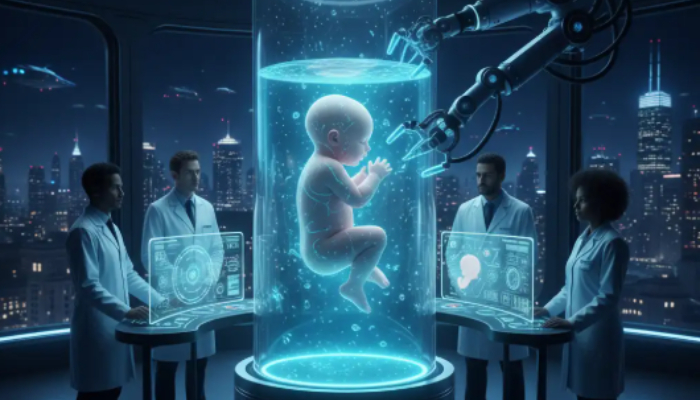
Imagine a tiny robot arm, guided by artificial intelligence, delivering a single sperm into an egg — and nine months later, a healthy baby boy is born. Sounds like science fiction? Not anymore. This real-life miracle happened in Guadalajara, Mexico, where a 40-year-old woman gave birth to the world’s first baby conceived through AI-assisted IVF. The fertilisation was carried out by a robot remotely operated by specialists in New York, marking a turning point in reproductive medicine.
Science Behind the Breakthrough
At the heart of this historic event lies Intracytoplasmic Sperm Injection (ICSI), a process where a single sperm is injected into an egg using a microscopic needle. Traditionally performed by expert embryologists, this delicate procedure has now been revolutionised by automation.
The AI-powered robot, developed by Conceivable Life Sciences, performs the ICSI process with 23 precise, pre-programmed steps — from sperm selection to injection — achieving near-perfect accuracy. Out of five eggs fertilised, four developed into embryos. While the first transfer failed, the second succeeded, making history. Fun fact: the robot’s parts were built using a Sony PlayStation 5 controller and a microscope camera, proving that innovation often begins with creativity.
Why This Changes Everything
IVF success has always depended on human skill, intuition, and chance. But AI changes that equation. By learning from data, it identifies the healthiest sperm and embryos, reducing human error. As Dr Erkan Buyuk, a reproductive expert, explains, automation could standardise IVF and drastically increase success rates. AI doesn’t get tired or distracted — it’s a tireless embryologist in digital form.
Future of Fertility
Currently, IVF costs in India range from Rs 1.5 lakh to Rs 3 lakh per cycle, with many couples needing multiple attempts. With automation, experts like Dr Emily Jungheim believe IVF could become more affordable and accessible globally. Alejandro Chavez-Badiola, co-founder of Conceivable Life Sciences, envisions every IVF lab having its own robotic embryologist.
Hope and Ethical Questions
Infertility affects over 48 million couples worldwide, and for many, AI-assisted IVF is a beacon of hope. Yet, ethical concerns linger. Who’s responsible if something goes wrong — the doctor, the coder, or the machine? Experts stress that human oversight remains vital. As Dr Jungheim wisely puts it, “AI may handle the how, but humans must still decide the why.”
A New Dawn in Reproductive Science
From the world’s first test-tube baby in 1978 to today’s AI-conceived child, fertility science has crossed another frontier. The first AI+IVF baby represents not just a technological marvel but a new chapter in humanity’s journey.