
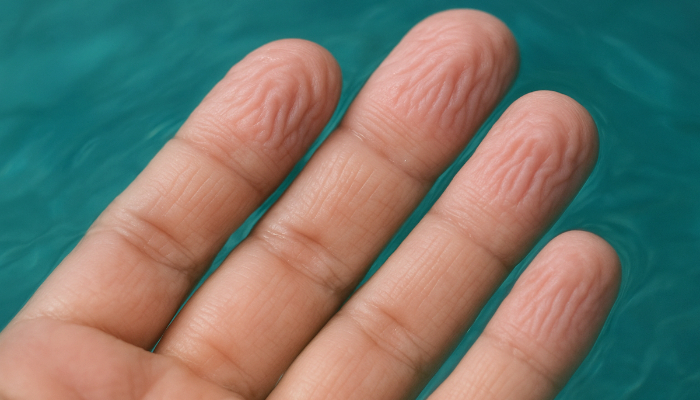
Spend a few minutes in a bath or swimming pool, and your fingers start to wrinkle, almost like prunes. But this familiar change isn’t just cosmetic. Scientists have discovered that finger wrinkling is controlled by the nervous system, not merely water absorption. Interestingly, only fingers and toes wrinkle, while other body parts remain smooth. Researchers believe this phenomenon may have an evolutionary purpose, helping improve grip on wet surfaces. It may also reveal clues about your health, with changes in wrinkling linked to nerve function and certain medical conditions.
How Fingers Wrinkle Form
Fingertip wrinkling begins within just a few minutes, faster in warm water and slower in cooler temperatures. Earlier studies suggested that the skin simply absorbed water, but patients with nerve injuries showed that wrinkling requires a functioning nervous system. Blood vessels constrict in response to water, which pulls the skin inward and forms ridges on the fingertips. This demonstrates that finger wrinkling is an active process controlled by nerves, not merely passive skin swelling.
Wrinkles Improve Grip
Scientists believe this wrinkling helps humans hold wet or slippery objects more securely. Experiments measuring blood flow in soaked hands confirm that nerves trigger the process. Changes in salt balance around sweat ducts activate nerve fibres, causing skin contraction and the familiar wrinkles. Beyond evolution, doctors note that abnormal wrinkling can reveal health issues such as nerve damage, diabetes, or circulation problems, making it more than just a curious quirk of the body.